
For much of the first half of my life, I believed there was something deeply wrong with me.
Not physically wrong. Not sick.
Something much harder to explain.
I felt flawed at the very core of who I was—as though everyone else had somehow been given permission to be here, and I hadn’t.
Of course, I didn’t tell people that.
I learned to look okay.
I smiled. I functioned. I did what needed to be done.
And underneath it all, I felt like a fraud.
I was carrying around a version of myself that I hoped would be acceptable while hiding the person I believed wasn’t.
That is an exhausting way to live.
Eventually, I entered a very long period of trying to fix myself.
And in many ways, I did change.
I healed wounds. I became stronger. I developed courage and awareness. I learned more about myself. I began caring less about what other people thought of me—and oh, what a wonderful freedom that was!
Many of those qualities are still part of who I am today.
None of that work was wasted.
But there was something I didn’t understand yet.
Becoming stronger wasn’t the same thing as becoming more authentic.
Trying to Belong
By then, I was working as a professional coach and helping other people with their own personal development.
I loved the work.
It felt aligned with who I had become.
Then I heard about an opportunity to coach executives in large corporations.
I applied.
The interviewing and approval process was long and very thorough, but eventually I was accepted as a subcontractor with The Ken Blanchard Companies.
I had earned my place.
And almost immediately, that old feeling returned.
Fraud.
It wasn’t because I couldn’t do the work.
I knew I was doing a good job with my clients.
The discomfort appeared when I interacted with the other coaches and managers. Many had impressive academic backgrounds and advanced degrees. I didn’t.
And suddenly I felt small again.
Insecure.
Undeserving of being there.
So I did something I had learned to do very well.
I put up a front.
I tried to look as though I belonged in a world where, somewhere deep inside, I never truly felt that I did.
And then I kept doing it.
For twenty years.
Corporate coaching was only one part of my work, but I stayed connected to that world year after year.
Why?
There were certainly practical reasons.
One of them was money.
Letting go of that income wasn’t easy.
But eventually, about two years ago, I did.
I walked away from corporate coaching.
And what I felt was unmistakable.
Freedom.
No more pretending.
No more trying to belong.
No more fraud.
Or perhaps more accurately:
No more feeling like one.
The Question I Hadn’t Been Asking
Looking back, I can see that for years I had been asking myself the wrong question.
Some version of it had followed me throughout much of my life:
Am I good enough?
Am I good enough to be here?
Am I accomplished enough?
Educated enough?
Professional enough?
Do these people think I belong?
Can I prove that I deserve my seat at the table?
I spent years becoming stronger and more confident so I could answer those questions with a yes.
But there was another question I wasn’t asking.
A much simpler one.
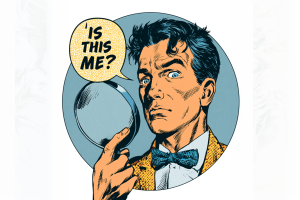
Is this me?
Not:
Can I do this?
I could.
Not:
Am I good at this?
I was.
Not:
Can I make money doing this?
I could.
Not even:
Do other people think I belong here?
Is this me?
That question changed everything.
The Cost of Leaving Ourselves Behind
Today, when I look back at those years, I recognize something that is difficult for me to admit.
I was abandoning myself.
And at times, I was betraying myself.
Nobody was forcing me to stay.
I knew there was discomfort inside me, and instead of becoming curious about it, I repeatedly told myself to keep going.
I had reasons.
Very reasonable reasons.
But underneath those reasons was a quiet part of me saying:
This isn’t who I am.
And I wasn’t listening.
We talk a lot about authenticity as though it means being honest, speaking our mind, or not worrying about what other people think.
I think it goes much deeper than that.
Authenticity is the relationship we have with ourselves.
It is whether we are willing to hear ourselves when something inside says:
This doesn’t feel true.
We all know that feeling.
At least I think we do.
For me, inauthenticity has a particular feeling in my body.
It is heavy.
Grey.
Stuck.
I feel it somewhere deep in my gut.
It doesn’t necessarily scream.
That’s what makes it so easy to ignore.
It just sits there.
And when I ignore it long enough, something in me begins to shrink.
My energy changes.
My self-respect erodes a little.
And every time I knowingly continue doing something that feels fundamentally untrue to me, I send myself a message:
What I need from you right now matters more than what you are trying to tell me.
That is a very high price to pay.
Authentic Doesn’t Always Mean Comfortable
There is something important I want to say here.
Being authentic does not mean avoiding everything that makes us uncomfortable.
Sometimes the most authentic choices we make are terrifying.
Sometimes something is difficult precisely because we are growing.
Sometimes we want to run because we are afraid—not because the direction is wrong.
So discomfort alone isn’t the answer.
Fear isn’t necessarily the answer either.
Authenticity asks for something more subtle.
It asks us to become very quiet and very honest.
Am I afraid because this is stretching me?
Or:
Am I uncomfortable because I am trying to be someone I am not?
Those are very different things.
And nobody else can answer that question for us.
Is This Me?
These days, I ask myself that question often.
Is this me?
If the answer is a resounding yes, wonderful.
If it isn’t, I stop.
I look carefully.
I listen.
I don’t necessarily throw everything away or make an immediate dramatic change.
But I pay attention.
Because I have learned that there can still be places inside us—even after decades of self-discovery—that belong to some old idea of who we thought we needed to be.
A role.
An expectation.
A way of behaving.
A definition of success.
An identity we have simply worn for so long that we stopped noticing it wasn’t ours.
And when I discover one now, I want to know.
Because today, authenticity is no longer something I aspire to when it’s convenient.
It has become my first priority.
I love and respect myself too much now to knowingly abandon and betray myself.
That doesn’t mean I will never be inauthentic again.
I’m human.
There will probably always be another layer to discover.
But whenever I uncover another place where I am pretending, performing, accommodating, or living according to an idea of who I should be, I want to stop.
Listen.
And ask myself:
Is this me?
I don’t always know the answer immediately.
But I am no longer willing to stop asking the question.
Maybe you know that feeling too—a place in your own life where the question has been waiting quietly in the background.
Not:
What will people think?
Not:
Shouldn’t I be happy with this?
Not:
Haven’t I invested too much to change now?
Just:
Is this me?
You don’t have to tell anyone else the answer.
You may only need to notice what comes up when you ask.
And if you have discovered a place in your own life where you were living as someone you thought you were supposed to be, I would love to hear what happened when you finally listened to yourself.
Come sit with me on The Bench and tell me your story.